UNIFORMS AND FOODBORNE ILLNESSES – PART 1/2
WEAVING FOOD SAFETY FROM YARN TO DRYING
In the foodservice and hospitality industry, the kitchen staff’s uniform constitutes, quite literally, their armor to effectively protect them from work-related friction and environmental conditions.
By definition, every textile garment is produced from fabric, which is the result of interlacing or weaving yarns. Traditional, artisanal textile production still routinely interlaces yarns or strands of different materials on the loom: for instance, cotton for the warp (the strands or yarns flowing vertically) and linen for the weft (the horizontal yarns interlacing the warp).
However, in the modern textile industry, fabrics are configured as blended textile materials prior to the weaving process. Modern textiles benefit from a characteristic known as «intimate blending,» where the yarn is crafted or spun using microscopic segments of two or more materials, embedding their properties directly into the filament—such as elasticity and strength.
In the case of drill (or heavy twill)—the fabric used to manufacture most uniforms in our industry—polyester-cotton blended yarns are the preferred choice for weaving into a viable textile. Within this blend, cotton provides freshness and comfort, while polyester contributes strength, tenacity, dimensional stability, and low permeability.
Another critical factor to consider is fabric weight. In textiles, weight is expressed as the relationship between mass and surface area: ounces per yard square (oz/yd²). The industry standard for this material ranges between 4.9 and 7.1 oz/yd². This density is a direct consequence of either one or both of the following factors: yarn thickness (or count) and loom compaction (the number of yarns per inch).
Ultimately, the weaving shape or pattern of the warp and weft—as seen in the illustration—shapes the drill fabric, transforming it into a lightweight textile armor or a «textile chainmail» that is highly resistant to mechanical agents, fluids, deep fryer oil splatters, and even functions as a thermal barrier. From the shuttle of ancient looms to the rapiers and jet looms of their modern descendants, the basic principle remains identical: passing the weft yarns over or under the warp yarns. When the weft yarn interlaces the warp in an offset two-by-two or three-by-three pattern, it creates a weave known as «Twill» (or Sarga).
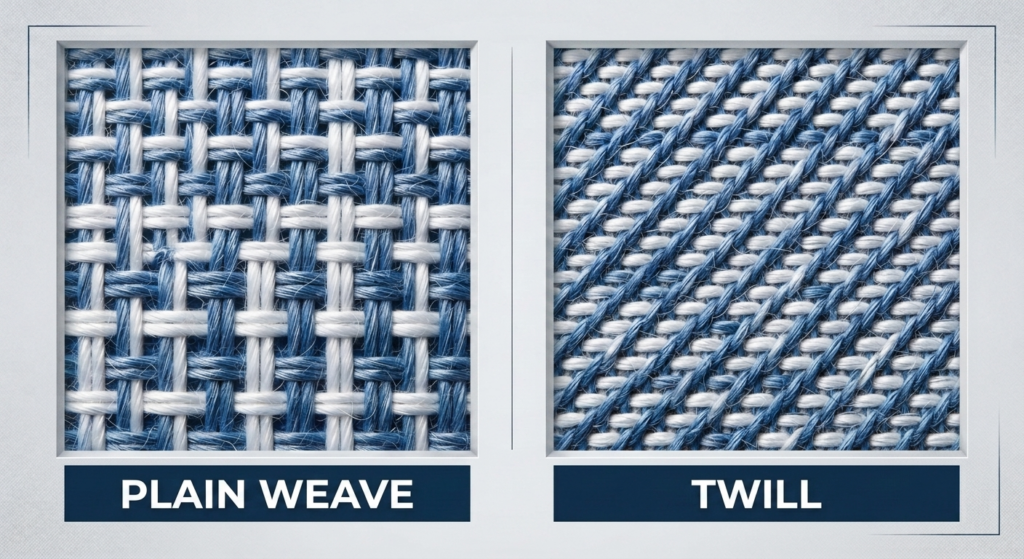
This specific pattern grants drill fabric the following characteristics:
Resistance to Friction and Fluid Impact
- The Mechanical Phenomenon: In a traditional plain weave (taffeta), the yarns cross each other one-by-one in a rigid grid, leaving exposed square pores. In a twill weave, by passing the weft yarn over two or three warp yarns before going under, the strands compact much closer together.
- The Result: This microscopic density acts as an «inclined plane» or a ramp. When a dense fluid (such as boiling oil or blood) strikes the fabric, instead of penetrating directly through the pores, it slides and glides over the diagonal ridges. This grants the professional critical seconds to remove the garment before the liquid reaches the skin.
Insulation Against Thermal Shock (Ovens and Walk-In Freezers)
This is where heavy twill drill excels against extreme thermal shocks, such as opening an oven at 392 °F or stepping into a walk-in freezer at 0°F (-18°C):
- The «Thermos Effect» (Air Chambers): The three-dimensional relief and diagonal ridges of the twill weave create a thicker, more voluminous fabric than a plain weave of the same weight. This volume traps micro-pockets of still air between the yarns.
- Facing the Oven (Radiant Heat): Upon opening the oven, the blast of dry heat collides with this barrier of trapped air within the twill. Still air is a poor thermal conductor, meaning it acts as a shield that slows the transfer of heat toward the chef’s torso.
- Facing the Walk-In Freezer (Extreme Cold): When entering the freezer, that same trapped air works in reverse: it retains the user’s body heat and buffers the impact of the freezing draft, preventing a direct thermal shock to the muscles.
Tear Resistance (Mechanical Friction)
In a kitchen or industrial environment, constantly brushing against the sharp edges of stainless steel counters, oven handles, or freezer racks destroys ordinary fabric. By utilizing longer diagonal floating yarns, twill possesses the physical property of distributing the force of an impact or snag across multiple yarns simultaneously, rather than straining a single point. Consequently, it is virtually impossible to tear under daily friction.
«Twill is, in essence, a flexible textile armor. Its diagonal relief is not a design whim, but a defensive geometry: it densifies the yarns so that hot liquid splatters slide off rather than penetrate, and it generates micro-chambers of trapped air that insulate the user’s body from violent thermal shocks—such as the fiery blast of an industrial oven or the icy chill of a walk-in freezer.»
Twill Drill and Food Safety
We frequently look for panaceas in everything we do or conceive, often compromising a minimum of objectivity to separate myth from science. I consider it essential to outline certain aspects of drill fabric below:
The Weave Myth (Structure vs. Composition)
The visual pattern (the twill diagonal) is not a biological shield on its own, but a mechanical solution. Its density slows down the initial penetration of high-impact fluids (splatters), but the true «highway» or «barrier» for bacteria is the chemical composition of the fiber:
- Cotton (Hydrophilic): Absorbs biological fluids (sweat, food juices). If the uniform remains damp, the core of the fiber acts as a Petri dish (incubator), making it easy for bacteria to colonize the fabric.
- Polyester (Hydrophobic): Repeles water. It keeps pathogens on the outer surface exposed to the air, which accelerates their desiccation (death by dehydration).
The Impact of Intimate Blending on Hygiene
The intimate blend (where each yarn is 65% polyester and 35% cotton) is crucial because:
- It eliminates unprotected zones: If the fabric had separated yarns (a polyester warp and a cotton weft), there would be pure cotton «channels» accumulating moisture and bacteria right alongside dry lines of polyester.
- The homogeneity of intimate yarn ensures uniform penetration: Sanitizing detergents and high industrial wash temperatures—fundamental for disrupting the cellular membrane of pathogens—can penetrate evenly without warping or selectively destroying parts of the uniform.
The Concept of Structural Cross-Contamination
If we evaluate twill drill fabric within a kitchen environment, its diagonal ridges visually camouflage organic stains (blood, grease, sauces). This is a double-edged sword: a uniform that looks clean is not necessarily sanitized. Microscopic residues trapped within the twill’s structural relief can be transferred via physical contact (fomites) to workstations or directly onto ready-to-eat foods.
International health agencies (such as the US CDC and HACCP food safety regulations) establish that eliminating pathogens in twill/drill textiles is achieved by strictly controlling wash temperature, time, and chemical agents without degrading the polyester and cotton fibers.
The fundamental guidelines to guarantee efficient sanitization are:
The Thermal Factor: Time and Temperature
Heat is the most efficient method to denature the proteins of bacteria (Staphylococcus aureus, E. coli) and viruses.
- The Industrial / Healthcare Standard (High Temperature): The US CDC recommends washing at a minimum temperature of 160 °F (71 °C) for at least 25 minutes. This combination destroys the vast majority of microorganisms through thermal shock. A high-quality intimate blend drill (65/35 polyester/cotton) handles this cycle perfectly.
- The Efficient Hospitality Standard: Microbiological studies show that washing at 140 °F (60 °C) is the minimum effective threshold to eliminate common kitchen pathogens, provided it is complemented by a continuous thermal drying cycle.
- The Danger of 104 °F (40 °C) or Below: Washing at low temperatures to «save energy» does not kill bacteria. In fact, it creates a «germ soup» inside the washing machine, triggering cross-contamination between garments.
The Chemical Factor: Sanitizing Agents
Ordinary detergent only dislodges grease and organic matter through mechanical agitation. To disinfect or eliminate microorganisms at a chemical level, specific agents are required:
- Chlorine (Sodium Hypochlorite): The most potent and cost-effective disinfectant. For white kitchen textiles, a pre-chlorination of 50 to 150 ppm (parts per million) of free chlorine in the wash cycle guarantees sanitation. Chlorine activates optimally between 135 °F to 144 °F (57 °C to 62 °C). Important Warning: Excessive chlorine usage rapidly degrades cotton and causes polyester to yellow over time.
- Active Oxygen-Based Bleaches (Sodium Perborate or Percarbonate): Essential for colored uniforms or garments with embroidered logos where chlorine cannot be used. They release hydrogen peroxide starting at 140 °F (60 °C), disrupting pathogen cell membranes via oxidation without fading the fabric.
- Quaternary Ammonium Textile Sanitizers (Quats): Chemical compounds added during the rinse cycle (where fabric softener typically goes). They are crucial if a uniform must be washed at a low temperature, such as 86 °F to 104 °F (30 °C to 40 °C), as they eliminate 99.9% of bacteria through chemical binding. Recommended dosage: 200 to 400 ppm.
Angelo Campione – FMP