CROSS-CONTAMINATION AND CROSS-CONTACT ─ PART 2
ESSENTIAL COGNITIVE KEYS FOR DIFFERENTIATION (II)
F&B INDUSTRY TACTICAL GUIDE (PART II): THE ANATOMY OF CROSS-CONTACT AND THE DANGER OF THE ALLERGEN
Having shielded processes against biological pathogens, high-end operations face an enemy of a completely different nature, invisible yet devastating: allergen proteins. Understanding cross-contact is not a matter of microbiology, but of biochemistry and civil liability. In this second part, we establish the definitive line of defense to protect the health and even the life of the diner.
The Neuro-Management of Diner’s Confidence
The customer who suffers from a severe food allergy visits a F&B establishment experiencing a latent state of hypervigilance and anxiety. They know that a single error in the kitchen’s chain of command can trigger a lethal autoimmune response. When an operation demonstrates an absolute mastery of cognitive safety triggers, communicating its protocols with absolute clarity and precision, it transmutes the customer’s anxiety into unshakeable loyalty or preference toward the brand. We do not just sell food; we sell predictability, safety, and control of the environment.
Isolation Protocols for Allergens
Unlike biological contamination, cross-contact occurs when a food allergen (a protein perfectly healthy for the rest of the population) is inadvertently transferred to an allergen-free food. Managerial attention here!: The pathogens involved in cross-contamination are destroyed through thermal cooking (heat). The proteins involved in cross-contact ARE NOT destroyed by heat. If a beef steak touches a grill contaminated with cheese (dairy) residues, cooking the steak to a well-done temperature will not eliminate the protein that triggers the allergy.
Global studies confirm that between 11 % and 13 % of the world’s population suffers from food-related immunological conditions. Although the FDA documents hundreds of reactive agents, 85 % of critical episodes in the F&B sector are caused by «The Big Nine» major food allergens: Milk, fish, crustacean shellfish, eggs, tree nuts, peanuts, soy, wheat, and sesame.
The Autoimmune Response
When the diner’s immune system detects the invading protein, it initiates a disproportionate defensive sequence: a massive release of histamines, skin irritation, vomiting, anaphylactic shock, and the dreaded closure of the glottis that prevents mechanical oxygenation. The outcome can unfold within minutes and can be fatal.
Step-by-Step Operational Protocol:
For operations that decide to assume this exclusive market with high responsibility, it is fundamental to be guided by the following sequence of steps:
- Personal Hygiene and Apparel Segregation: Personnel assigned to the order of an allergic customer must execute a deep handwashing procedure (including forearms), put on fresh nitrile gloves, and wear a differentiated apronto prevent traces adhered to the regular uniform from coming into contact with the customer’s dish.
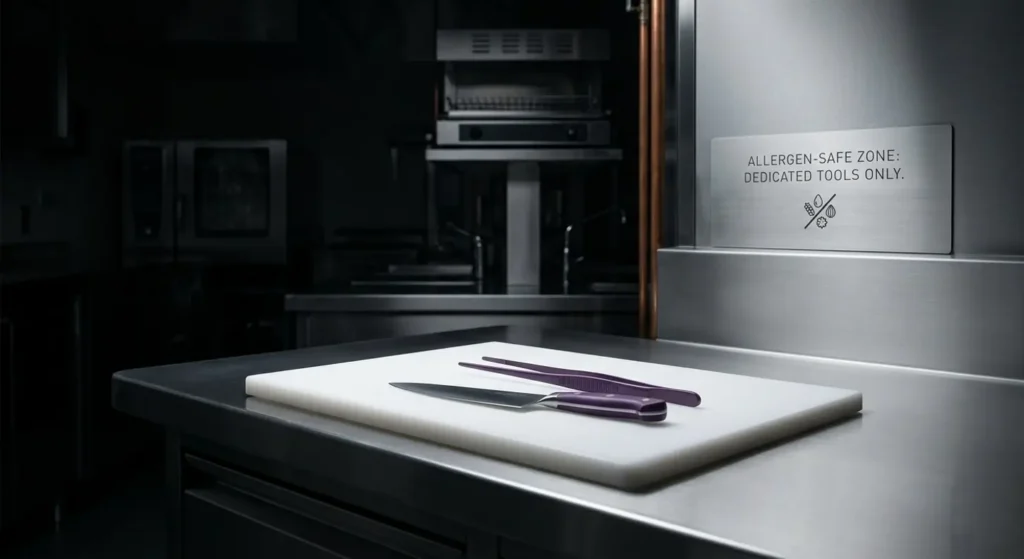
- Isolation of the Work Surface: A «Zone Zero», Sandbox, or Exclusion Zone must be delimited within the kitchen. A physically separated station, cleaned and sanitized exclusively for this purpose, free of airborne flours or splatters from mixed oils.
- Armored Utensil Battery: The use of knives, spatulas, pans, and stainless steel bowls must be exclusive for allergens (preferably identified with purple handles). It is strictly forbidden to use the oil from the common fryer to prepare an allergen-free product (e.g., frying potatoes in the same oil where shrimp were fried).
- Ingredient Label Auditing: Rigorous control of convenience products (sauces, dressings, concentrated broths). Labels must be audited in search of statements regarding «traces» or manufacturing warnings in shared processing plants, since the manufacturer often processes multiple packaging lines.
Conclusion
The effective prevention of both phenomena does not rely on luck, but rather on Commitment and Clear Operational Policies, alongside the continuous training of the human factor. A trained team does not view the protocol as a restriction to their speed, but as the armor that protects the brand’s heritage and the lives of those who sit at our tables.
Angelo Campione ─ FMP