OPERATIONAL TRANSPARENCY
AS A LEAKAGE MITIGATION STRATEGY IN FOOD COST MANAGEMENT
In today’s macroeconomic environment, margin optimization within the hospitality and foodservice industry is not solely achieved at the supplier negotiation table, but in the micro-monitoring of internal process flows. Recent data from the National Restaurant Association (NRA) in its latest State of the Industry report reveals an alarming metric: inventory deviations and uncontrolled shrinkage (commonly known as «internal theft») account for 8% to 13% of an operation’s net revenue, depending on the segment (Fast Casual, Fine Dining, or Quick Service Restaurants – QSR).
Given this scenario, implementing an isolated environment design (Segregated workstations) within mass production and portioning areas becomes a financial imperative. This is where an apparently simple shift in waste management architecture radically alters the food cost curve: replacing opaque waste bins with transparent containment systems secured to ergonomic metal support frames.
The Semiotics of Transparency in QSR Formats
Quick Service Restaurant (QSR) models that operate with remote production centers or raw material processing areas isolated from the main service line have adopted this practice with remarkable success. By securing high-density transparent bags to metallic rings with independent support legs, the physical opacity of food waste is eliminated.
From the perspective of neuromarketing applied to operational efficiency, this layout creates an invisible choice architecture.
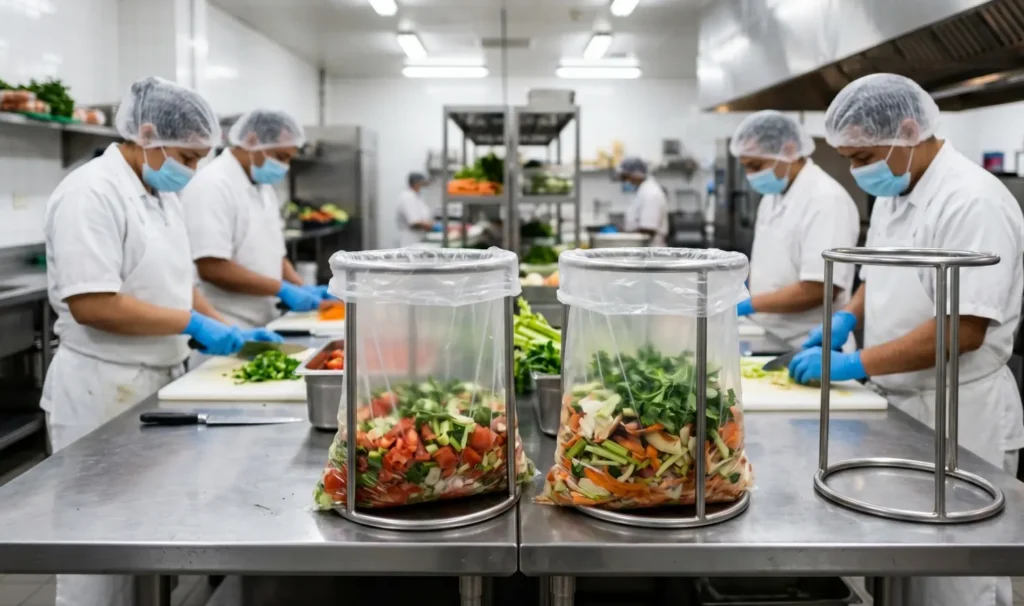
The Kitchen Manager or floor supervisor does not need to interrupt the brigade’s biomechanical flow to audit portioning yields; a continuous, simple visual scan allows real-time identification of whether discarded tomato skins, potato peels, or protein trimmings exceed the standard parameters of the raw material’s technical yield.
Total visibility acts as a behavioral anchor, mitigating ingredient diversion and ensuring that isolated zones remain not only hygienically secure against cross-contamination but strictly supervised during the pre-production stage.
Value Transfer to Fast Casual and Fine Dining
There is a common misconception that this practice belongs exclusively to high-volume or industrial production. However, the greatest opportunity for value capture lies within the Fast Casual and Fine Dining segments. In these formats, while the volume of processed raw materials may be lower, the unit cost of ingredients is significantly higher.
A minor deviation in premium proteins, truffles, artisanal cheeses, or specialty produce impacts the Food Cost with a mathematical intensity far superior to that of a quick-service format. By implementing preparation stations equipped with this continuous visual control, operations management achieves two simultaneous strategic goals:
- Sanitary Risk Mitigation: Maintaining the compartmentalization of waste zones in a hygienic and ergonomic manner.
- Predictive Cost Optimization: Inhibiting behaviors that foster micro-inventory leaks, as every discarded element retains its visual identity until the final shift disposal.
Food cost management must not rely exclusively on retrospective audits at the end of the month; it must be executed live. Physical transparency on the waste line is the most cost-effective, seamless, and sophisticated tool to transform waste into a real-time analytical control dashboard.
Angelo Campione ─ FMP
Sources
Scenic Environment Engineering: The Psychology of Visual-Perceptive Control in Waste Mitigation
From the psychology of perception and applied semiotics in process control, the use of opaque containers in an industrial kitchen generates a «cognitive blindness» effect regarding waste. What remains unseen effectively ceases to exist within the brigade’s subconscious. By introducing radical transparency, we alter organizational behavior through a subtle yet powerful mental trigger of visual accountability.
This is not merely surveillance; it is about modifying the perceived value of the raw material. When an operator is aware that their actions leave an immediate visual footprint, it activates both the conformity bias and loss aversion. Waste shifts from being “anonymous trash” into an explicit signifier of efficiency—or inefficiency.
For Fast Casual and Fine Dining formats—where high-value protein and botanical inputs critically elevate food costs—this transparency acts as a semiotic mirror. It effectively reduces the information asymmetry between management and the execution line, mitigating silent capital leaks (internal shrinkage and theft) without the need to deploy invasive, coercive measures that disrupt the workplace climate. This is the elegance of choice architecture (Nudge Theory) leveraged for pure profitability.
Sylvana Bianchi ─ MD