THE GREAT RESET
THE CHEMICAL SHOCK ANATOMY AND THE INTEGRATED PEST MANAGEMENT DOCTRINE
I. Introduction: The Single-Remedy Fallacy and the Tactical Integration Doctrine
Within the senior management spectrum of Food and Beverage operations, a deeply rooted operational myth persists, bleeding maintenance budgets and exposing the biological safety of facilities: the belief that chemical fumigation alone is the ultimate solution against pests. The average manager assumes a passive stance, ignoring that the skeletons hidden in the operational closet are the structural gaps of an open infrastructure and deficient hygiene. For a Foodservice Management Professional (FMP), this unidimensional approach is a costly financial mistake and a sanitary hazard. Chemical fumigation as such IS NOT INEFFICIENT, but its true performance only solidifies when it is processed as a component within a superior system: Integrated Pest Management (IPM).
IPM is not an isolated action; it is precisely that: integrating critical tools to present a unified and unyielding battlefront against the biological enemy. This doctrine is founded upon a three-dimensional containment strategy: physical and structural BLOCKADE of access to the establishment (the perimeter customs barrier previously analyzed), internal chemical fumigation executed exclusively as a biological shock RESET, and periodic, controlled chemical application ONLY ON THE EXTERIOR of the building to mark the furthest and most hostile frontier. By integrating these forces, the FMP does not merely attack the physical presence of vectors; it radically alters their survival conditions. Sustaining long-term profitability and food safety demands a coordinated offensive that, in addition to denying them residence through engineering and chemical shock, absolutely denies them access to their two vital necessities: water and food.
II. The «Great Reset» Concept: Drastic Scenarios and Financial Impact
Within the architecture of IPM, internal tactical fumigation represents a major surgical intervention, a biological shock event that the FMP labels the «Great Reset». Unlike routine external applications, which act as a passive perimetral shield, the Reset is an internal operation of high logistical complexity that disrupts the normal operational flow of the establishment. An FMP contemplates the execution of this procedure solely under two drastic operational scenarios, each carrying diametrically opposed financial and reputational implications.
The first scenario is proactive and planned in nature. It is executed by leveraging a scheduled shutdown of operations—such as a major year-end maintenance closing or a renovation pause—immediately after successfully completing the physical engineering seal of the infrastructure. Executing the chemical shock at this juncture is an astute managerial move: with all structural borders closed, the chemical decisively eliminates any residual population trapped inside, guaranteeing that when operations resume, the physical plant restarts with a biological load of zero. The second scenario, conversely, is reactive in character and represents a critical emergency situation: a mandatory intervention in the face of an active chronic infestation. This second context is a regrettable scenario for senior management; it implies that previous controls failed or were non-existent. The reputational consequences of a visible infestation take years to heal in the local market, and the financial impact doubles due to the need to halt operations unexpectedly, destroying daily cash flow and triggering severe commercial penalties.
III. Pre-Shock Logistics: The Surgical Preparation Protocol
Sanitary success and economic return on the «Great Reset» are decided in the hours leading up to the release of the chemical agent. Treating a professional kitchen as if it were a general cargo warehouse, allowing the pest control company to act without a rigorous preparation of the environment, is an administrative negligence that leads directly to massive losses from cross-contamination and asset destruction. The FMP leads a surgical preparation protocol that mandatorily involves both the kitchen and maintenance brigades.
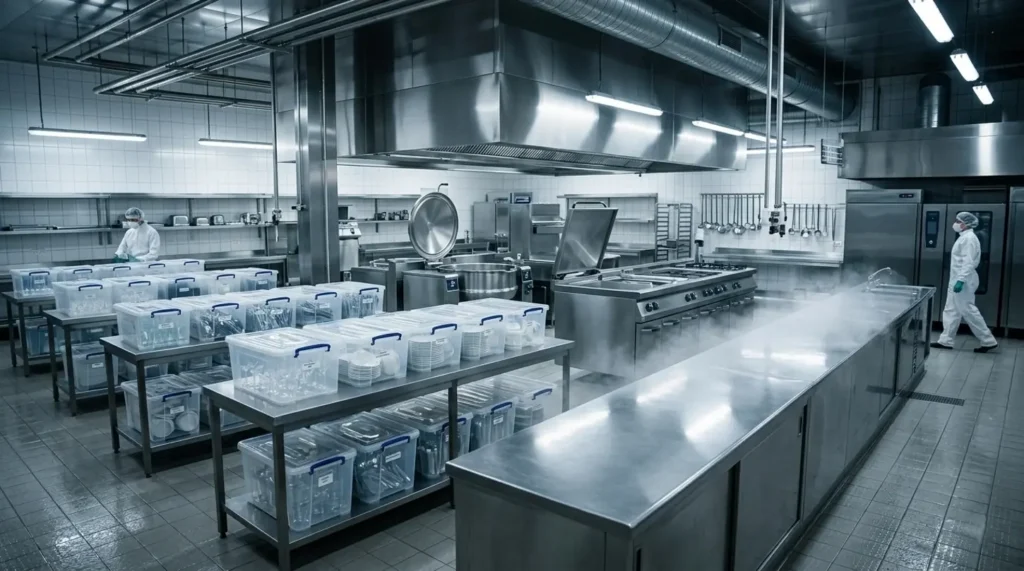
The first line of this protocol demands the absolute evacuation or hermetic confinement of all exposed service utensils. All smallwares, glassware, flatware, and fine table linens must be completely removed from production zones and stored in an isolated clean area, or failing that, confined inside sanitary plastic bins hermetically sealed with high-density industrial film. Concurrently, dry food inventories that are not in factory-sealed rigid hermetic packaging must be transferred to a closed, secure storage area outside the chemical vapor dispersion zone. Those supplies that due to logistical reasons cannot be mobilized must be protected using industrial-gauge plastic covers specifically certified for the retention and impermeability of gases and suspended chemical particles. The FMP understands that a single error in this preparation phase can cause toxic chemicals to impregnate porous materials or secondary cardboard packaging, forcing a total discard of the inventory and transforming a sanitary remedy into a direct financial loss for the Food Cost.
IV. The Chemical Exclusion Zone: Why Walk-In Units Must Never Be Fumigated
Within the inspection and preparation of the physical plant for the «Great Reset», there is an unnegotiable rule of strict technical-scientific rigor that every FMP applies and enforces severely: refrigeration and freezing walk-in units MUST NEVER BE FUMIGATED ON THEIR INTERIOR. Breaking this directive from the Food Code and international sanitary standards denotes a troubling technical ignorance and generates a devastating biological and financial liability for the establishment’s heavy equipment.
The prohibition against introducing pest control chemical agents inside cold storage chambers is based on two physical and mechanical principles:
Active Ingredient Deactivation: The extreme controlled low temperatures inside a walk-in unit (below 5°C in refrigeration and below -18°C in freezing) alter the thermodynamic properties of the vast majority of commercial insecticides and pesticides, inactivating or drastically reducing the effectiveness of their active ingredient. The chemical will not eliminate the pest, but it will deposit itself onto the surfaces.
Forced airflow contamination: Walk-in units operate via industrial evaporator systems that recirculate air under forced conditions at high speed. Introducing chemical vapors or atomized micro-droplets inside the chamber causes the fans to absorb the toxic agent, permanently and irreversibly contaminating the evaporator’s aluminum fins and copper coils. Furthermore, the chemicals degrade the elasticity of the doors’ magnetic seals (Gaskets), causing thermal leaks that spike electrical consumption. Every time the motor starts up, it will recirculate chemical residues over the stored raw materials, turning the walk-in into a perpetual contamination chamber.
V. Bypassing the Customs Reopening: Post-Treatment Protocol for Contact Surfaces
The true challenge for the operational brigade and the leadership of the FMP begins the exact instant the pest control company hands over the facility keys after meeting the exposure and ventilation times required by the MSDS (Material Safety Data Sheet) sheets. Upon reopening the doors of production areas, management must assume that all exposed heavy equipment acts as a biological and physical magnet for chemical residues. Elements such as industrial kettles, tilting skillets, combination ovens (combi), flat-top grills, charbroilers, and stainless steel worktables present an invisible layer of pesticide deposits that must be completely removed before lighting a single pilot or starting food portioning.
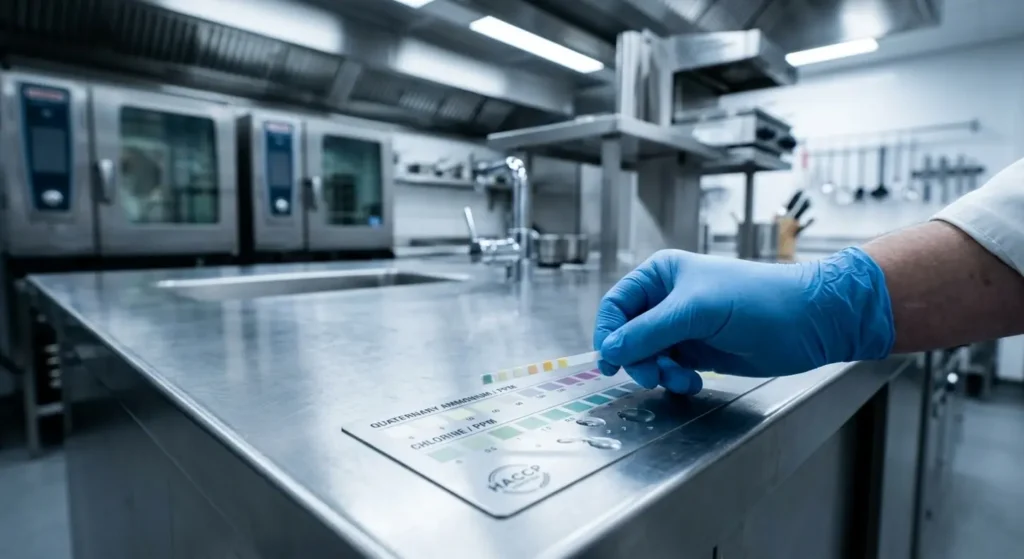
The post-treatment protocol demands a militarized trench discipline: staff, equipped with appropriate personal protective equipment, must execute a deep washing process using industrial alkaline detergents designed to break the molecular chains of chemical compounds. This wash is followed by a thorough rinse with pressurized potable water to clear away any soap and pesticide residue. Finally, the mandatory application of rapid-evaporation sanitizers certified by international agencies (such as the NSF and the FDA) specifically for direct food-contact surfaces is carried out, using solutions like fifth-generation quaternary ammonium or alcohol-based formulas, verifying their concentration via chemical titration strips. The «Great Reset» is a highly efficient tool for eliminating live threats at their root, but only this rigorous subsequent operational discipline guarantees that the chemical intervention does not translate into a massive poisoning of your diners and a definitive legal breach for the corporation.
VI. IPM Sustainability: Denying Residence, Water, and Food in the Daily Trench
Once the «Great Reset» has sanitized the interior of the physical plant and perimeter engineering has sealed off access points, the sustainability of the security ring depends on the daily hygienic maintenance policies of the kitchen. The FMP understands that pests are biological opportunists driven by an elementary logistical instinct: they look for shelter, water, and food. If the operation provides them with these three variables due to sloppy cleaning or negligent operational practices, the IPM shield will collapse in the short term, forcing a repetition of costly chemical cycles.
Daily strategy within the operation to maintain the external frontier is based on the absolute deprivation of resources:
Denying residence: This implies eliminating any accumulation of discarded equipment, cardboard packaging, or debris in technical corridors and perimetral zones that could serve as hidden nesting areas. The physical order of the plant is the pest’s worst enemy.
Denying water: Insects and rodents have a critical necessity for daily hydration. Leaving puddles of stagnant water on kitchen floors at the end of the shift, allowing persistent leaks in prep sink faucets, or neglecting the cleaning and drying of floor grease traps is equivalent to setting up a watering trough for vectors. The FMP demands the absolute drying of surfaces and immediate corrective maintenance of any plumbing leak.
Denying food: The accumulation of food micro-particles behind cooking lines, organic waste trapped in wall tile grout, or poor management of external waste containers are massive food sources. Internal trash cans must be kept hermetically covered and evacuated to the primary external dumpster at the end of each shift. Constant cleaning with industrial detergents and disinfectants is not an aesthetic act; it is the definitive method to erase the chemical and biological prints that attract vectors into the business.
VII. Conclusion: Tool Integration as an ROI Guarantee
Acting in FMP Way regarding health crisis management demands eradicating from corporate culture the blind and inefficient reliance on chemicals applied reactively. Technical and industrial analysis proves that internal chemical fumigation is not a magic solution per se, but rather a tactical shock resource requiring milimetric synchronization with architectural engineering and the daily hygienic discipline of the brigade. A robust Integrated Pest Management (IPM) program is the only strategy that guarantees return on investment by fusing the physical blockade of access points, controlled internal chemical resets, and absolute restriction of water, food, and shelter within the production workshop.
Hospitality senior management must understand that a true reputational shield and sustainable profitability are not bought in a gallon of cheap poison; they are designed by establishing a hostile frontier along the building’s exterior perimeter and a culture of zero tolerance for dirt on the inside. Relentlessly sustaining these surgical protocols of preparation and post-treatment is the definitive managerial praxis that protects the company’s inventories, defends consumer health, and ensures each service cycle takes place inside a biological fortress of high efficiency and unnegotiable financial performance.
Angelo Campione ─ FMP