SETTING THE STAGE
ENGINEERING VS. BIOLOGICAL CONTRABAND
I. Introduction: The Doctrine of Strategic Anticipation and the Reactive Fallacy
In the annals of military strategy and corporate crisis management, inaction and reactivity represent the fastest routes toward operational collapse. In Volume VI of his immortal work, History of the Peloponnesian War, the Athenian historian Thucydides laid down a maxim that condenses the very essence of leadership under pressure: «When danger presses, prudence advises anticipating the blow.» In the senior management of the foodservice industry, this classical aphorism must be adopted as the fundamental operational doctrine of a Foodservice Management Professional (FMP). Waiting for the visible signs of a pest infestation to manifest in the dining room or across kitchen prep lines before merely triggering an emergency fumigation contract is an unforgivable tactical error. Such a lack of foresight not only denotes technical illiteracy but also constitutes an administrative negligence that jeopardizes public health and the financial continuity of the enterprise.
For an FMP, Integrated Pest Management is processed under a holistic lens of preventive engineering and perimeter control. This is not a simple cosmetic cleaning service delegable to the lowest tier of the organizational chart; it is a senior management discipline directly linked to brand shielding, capital efficiency, and return on investment. Designing a hermetic environment based on physical engineering solutions is the only financial strategy that defends capital invested in infrastructure and raw materials. Food safety is not a fortuitous event improvised during daily operations; it is a physical condition that is planned, constructed, and sustained by absolutely closing the door on the biological enemy at the very border of the establishment.
II. The Logistic Analogy of Smuggling: The Vector as Criminal Transport
To accurately scale the level of threat posed by pests—rigorously classified within this operational environment as rodents, insects, and birds—the FMP must abandon euphemisms and analyze the situation through an analogy of large-scale criminal logistics and smuggling. In an industrial kitchen ecosystem, pathogenic microorganisms (bacteria, viruses, and fungi) are the illegal contraband merchandise: invisible, destructive, and lethal. On their own, these pathogens possess highly limited biological displacement capabilities; a Salmonella bacterium or a Norovirus cannot move independently from an outdoor municipal dumpster to the plating table of a fine-dining restaurant. They require a logistic network to multiply their radius of action.
It is at this exact point of the equation where pests assume their role as high-speed mechanical and biological vectors. For pathogens, a rodent, a cockroach, or a bird represents precisely what speedboats, modified armored trucks, and private jets represent for international narcotics networks. They are hyper-efficient, specialized, and fast transports that bypass standard sanitary customs, overcome the natural geographic limits of microorganisms, and smuggle contraband into sterile production zones. Biological transshipment within this smuggling network is perversely synchronized: viruses utilize parasitic insects, such as lice or mites, to transport themselves over long distances, exploiting their feeding cycle on rodents and birds to inject the viral load directly into their bloodstream, creating a second vector of greater coverage and displacement speed. Bacteria, for their part, board the vector through the direct ingestion of sludge and waste along the external perimeter. The critical danger to cash flow and brand reputation occurs at the «unloading» of the merchandise: pathogens are deposited onto stainless steel counters, service utensils, and raw materials when the pest excretes its own metabolic waste — salivation, regurgitation, urination, and fecal matter — onto food-contact surfaces. A single biological breach of this nature is capable of triggering an epidemiological outbreak that will summarily destroy sales and consumer trust in the brand.
III. Cognitive Separation: The Threat of Birds Versus Raw Materials
Within the spectrum of pests, the FMP must apply a strict cognitive separation when evaluating the presence of avian activity in the commercial environment, sharply and unnegotiably differentiating the concept of wild «birds» from the concept of «poultry» destined for human consumption. Confusing or softening these terms at a linguistic or operational level breaks the mental boundary dividing legitimate raw material from a pure contamination vector. Poultry entering the establishment consists of raw food items subject to rigorous temperature controls below 5 °C (41 °F) and strict cooking protocols for the elimination of Campylobacter or Salmonella. Wild birds (pigeons, sparrows, starlings), on the contrary, are live perimetral invaders that threaten the establishment’s food safety from the outside.
Wild birds are highly hazardous biological vectors that carry a massive load of pathogenic bacteria on their feet, beaks, and plumage, in addition to hosting mites and lice that act as secondary vehicles for viruses. Their nesting habits in ventilation areas, roofing, and loading docks represent an immense financial and sanitary risk. Their droppings and metabolic fluids contain corrosive acids that damage the mechanical components of outdoor air conditioning units and contaminate the forced air streams entering the building. When a bird manages to penetrate a dry raw material warehouse or a receiving zone, its mere presence immediately triggers a cross-contamination alert. The FMP trains operational personnel to recognize that birds are not decorative or harmless elements of the restaurant’s urban landscape; they are live logistic threats that must be excluded through physical engineering barriers before their waste destroys the integrity of food and the company’s asset value.
IV. Physical Engineering for Perimeter Blockade: Closing the Structural Customs
An FMP’s first line of defense is not executed with chemical atomizers or poisoned bait traps; it is designed through absolute physical engineering blockades along the structural perimeter of the building. If the architectural design of the establishment allows for gaps, cracks, or open clearances, the operation will be permanently subsidizing an infinite expenditure on reactive pest control. Profitable safety demands sealing infrastructure with industrial criteria of airtightness, transforming walls and access points into an impassable customs barrier for crawling insects, rodents, and birds.
The analysis of perimeter engineering must be executed systematically following the critical flows of the physical plant:
Roofing and ceiling joints: The joints and intersections between perimeter walls and roof structures are preferred entry and nesting points for birds and roof rodents. These breaches must be permanently sealed using high-resistance galvanized steel mesh or high-density industrial polyurethane foams combined with mechanical barriers that prevent gnawing penetration.
Spaces around utility penetrations and conduits: Every water connection, electrical wiring, gas network, or ventilation and exhaust duct traversing walls and exterior partitions represents an open highway for pests if left unaddressed. The FMP demands the hermetic sealing of these perimeter rings using metal flanges, hydraulic cement, or long-lasting elastomeric seals.Ventilation ducts and exhaust systems must mandatorily feature stainless steel deflector grates with openings small enough to stop the passage of flying insects and sewer rats, without strangling the operation’s airflow.
Sewage outlets and drains: Drainage networks are direct communication channels between the public sewer system and the interior of preparation zones. To halt the upward transit of rodents and crawling insects through pipes, the installation of one-way flow check valves and high-resistance security grates in every grease trap and kitchen floor drain is unnegotiable.
V. The Lower Zone of Doors: Door Sweep and Weatherstripping Technology
The most common vulnerable point in facility audits is located at the base of exterior doors and warehouse access entryways. A gap of just a quarter of an inch (6 millimeters) beneath a door provides enough space for a young rodent to displace its skeletal mass and enter the facility, while for crawling insects it represents a massive entry tunnel. The FMP mitigates this risk through the technical specification and installation of bottom sealing profiles, known internationally under FDA and ServSafe standards as heavy-duty door sweeps.
The selection of this micro-architectural engineering tool must not be left to chance or based on low-durability domestic commercial options:
Rubber and Neoprene Door Sweeps: Manufactured with solid elastomeric compounds of high mechanical and chemical resistance. They offer an absolute hermetic seal against the entry of exterior wash water and efficiently block the smallest crawling insects on perfectly leveled floor surfaces.
Brush and Nylon Bristle Door Sweeps: Composed of thousands of industrial high-density nylon filaments interwoven into an anodized aluminum or stainless steel channel. This technology is the most efficient for pest control at high-traffic entryways or floors with structural irregularities. The nylon bristles act as a dense, flexible mechanical barrier; when a crawling insect attempts to push past the profile, the physical resistance and friction of the filaments definitively halt its advance, completely cutting off its path without compromising the ease of opening and closing the door.
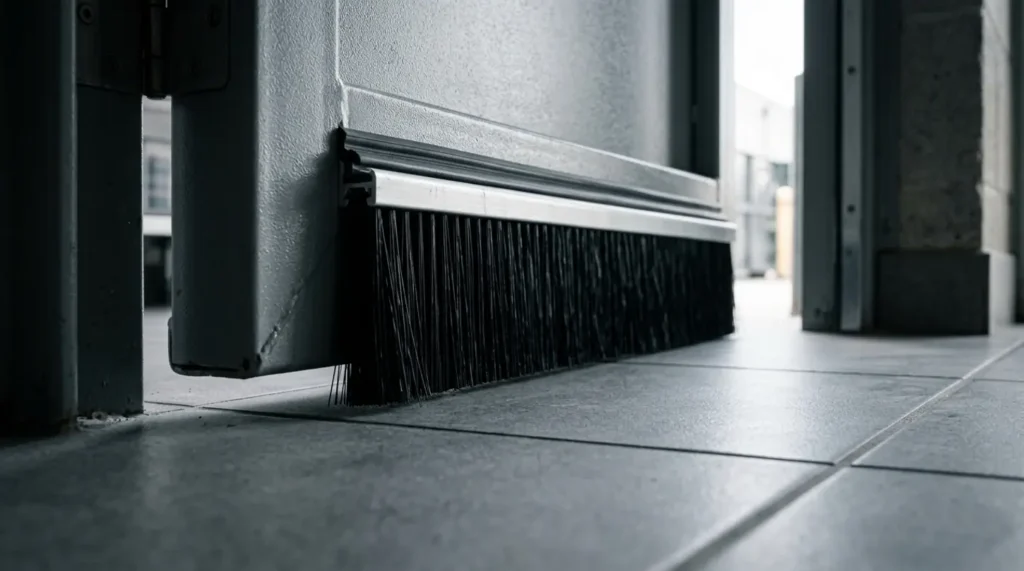
The FMP establishes a preventive maintenance program and daily verification to ensure these door sweeps remain calibrated, free from thermal degradation or mechanical tearing from friction, understanding that maintaining the physical integrity of the door base is the most economical and profitable action to shield kitchen inventory.
VI. The Receiving Dock as Commercial Customs: Logistic Trojan Horses
The effort to structurally seal the walls, roofs, and doors of a food facility is reduced to zero if the operation allows the enemy to cross the border camouflaged inside vendor shipments. The receiving dock is the commercial customs zone of the business. An FMP-standard protocol strictly prohibits the entry of compromised external packaging elements that act as logistic «Trojan Horses» for the voluntary introduction of pests into clean storage zones and walk-in coolers.
Corrugated cardboard and raw wood pallets are the primary vehicles for pest smuggling in the foodservice industry:
The danger of cardboard packaging: The corrugated structures of cardboard provide the perfect environment (latent humidity, cellulose, and thermal micro-cavities) for transporting German cockroaches and, fundamentally, their oothecae (egg cases). If the kitchen brigade allows vendor packaging boxes directly into dry warehouses or prep counters, it is actively importing a future infestation. The FMP policy demands the immediate unpacking of merchandise at the loading dock and the transshipment of products into the facility’s own sanitary plastic containers, sending external cardboard to the perimetral recycling bin immediately.
The danger of timber and wooden pallets: As established in general doctrine, raw wood pallets absorb biological contaminants and harbor wood-boring and crawling insects within their porous structures. Allowing a carrier’s wooden pallet to cross the perimeter line and sit inside a walk-in cooler breaks the plant’s sanitary shield. The FMP trains the brigade to ban the transition of these supports into internal areas, maintaining an exclusive inventory of certified HDPE plastic pallets for high-turnover internal storage.

VII. Conclusion: The Profitability of Preventive Design and the Culture of Exclusion
Acting in FMP Way regarding pest control demands replacing the old paradigm of reactive chemical extermination with the doctrine of physical exclusion and preventive engineering design. Fumigation is an efficient procedure for pest control only if it is accompanied by complementary mechanical measures. Financial analysis demonstrates that the costs associated with hermetically sealing infrastructure, installing high-quality industrial nylon bristle door sweeps, and performing preventive maintenance on drainage grates represent an insignificant fraction compared to the perpetual expenditure on recurring fumigations, legal penalties from sanitary closures, or the absolute collapse of sales due to the loss of brand reputation in the market.
Profitable food safety solidifies when this blocking infrastructure is combined with a rigorous operational culture and staff trained to severely audit the receiving dock. Food safety is not an abstract process; it is physically defended at the back door of the establishment, intercepting biological contraband before it has the opportunity to unload its pathogens into the kitchen’s value chain. The FMP leads the operation by transforming the facility into a sterile biological bunker, ensuring that every dollar invested in the business returns in operational consistency, asset protection, and sustainable profitability built on unnegotiable scientific and industrial foundations.
Angelo Campione ─ FMP