CONTAMINARIUM – 4/8
CATALOG OF FOOD AGENTS AND HAZARDS — BIOLOGICAL HAZARDS: PARASITES
In advanced health inspection, parasites represent a unique challenge: unlike bacteria, they do not multiply in food, but rather use it as a transport vehicle to infest the human host. Restaurant supervisors and operators must shatter the myth that parasites are an exclusive hazard of «low-grade kitchens.» Their skeletons are hidden in the operational closet of high-end culinary stations: the sushi bar, ceviche portioning lines, carpacci, and the washing area for hydroponic vegetables. Their major competitive advantage is that, although many are macroscopic (visible to the naked eye), the rushed operator does not train their eyes to hunt them in the prep sink.
Biological Specimens: The Enemies’ Profiles and Their Vectors
Specimen A: Anisakis simplex (The Raw Fish Worm)
A parasitic nematode whose life cycle involves marine mammals, fish, and crustaceans, and which colonizes the musculature of high-value commercial seafood.
The Enemy’s Profile: It is a cylindrical, whitish or translucent worm, 3/8 to 1 3/16 in long, usually found coiled like a spring within the fish viscera. The critical danger occurs when the fish dies: the parasite rapidly migrates from the viscera into the muscle tissue (the loin), remaining hidden between the veins of the flesh that the cook is about to slice.
Kitchen Vectors: The rushed sushi and ceviche station. The restaurant purchases salmon, hake, cod, or grouper «fresh from the beach» from an uncertified local supplier. The sushi chef or itamae, blindly trusting the product’s freshness, fillets the loin and serves a sashimi or a ceviche directly to the customer, completely omitting the mandatory prophylactic freezing protocol.
Physiological Effect: Acute Anisakiasis. The live parasite burrows its cuticular tooth into the customer’s stomach or intestinal mucosa. It triggers violent acute abdominal pain (simulating appendicitis), nausea, vomiting, and severe anaphylactic allergic reactions. In many cases, it requires emergency endoscopy to mechanically extract the worm before it perforates the gastric wall.
Kitchen Control Practice:
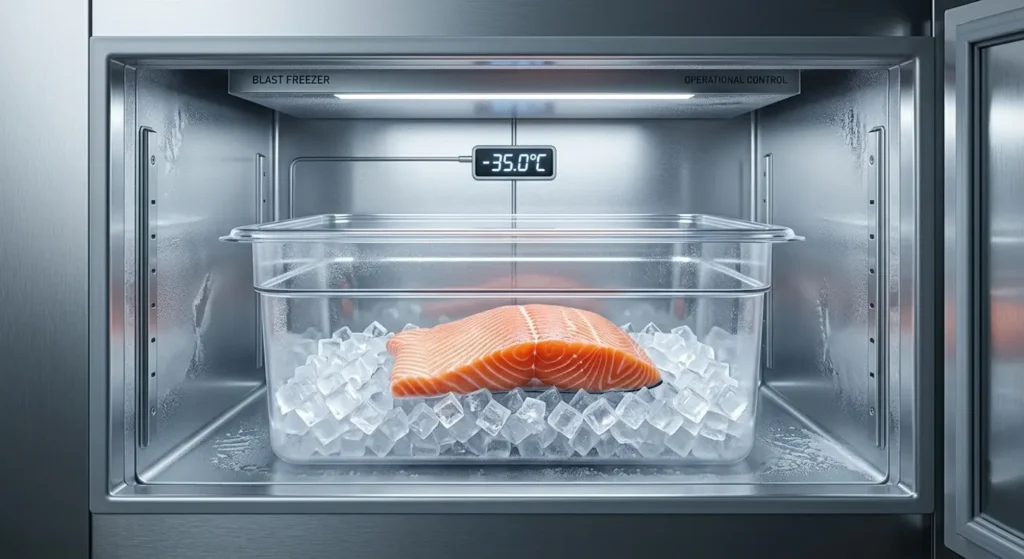
- Codex and FDA Food Code Golden Rule: All fish intended to be consumed raw, undercooked, or marinated must undergo mandatory commercial prophylactic freezing to -4°F (-20°C) for a minimum of 7 days, or to -31°F (-35°C) for 15 hours in a blast freezer.
- Mandatory visual inspection by palpation and candling at the clean fish portioning station.
Specimen B: Giardia duodenalis and Cryptosporidium parvum (The Green-Station Parasites)
Microscopic protozoans that form cysts and oocysts highly resistant to the environment and common chemical sanitizers.
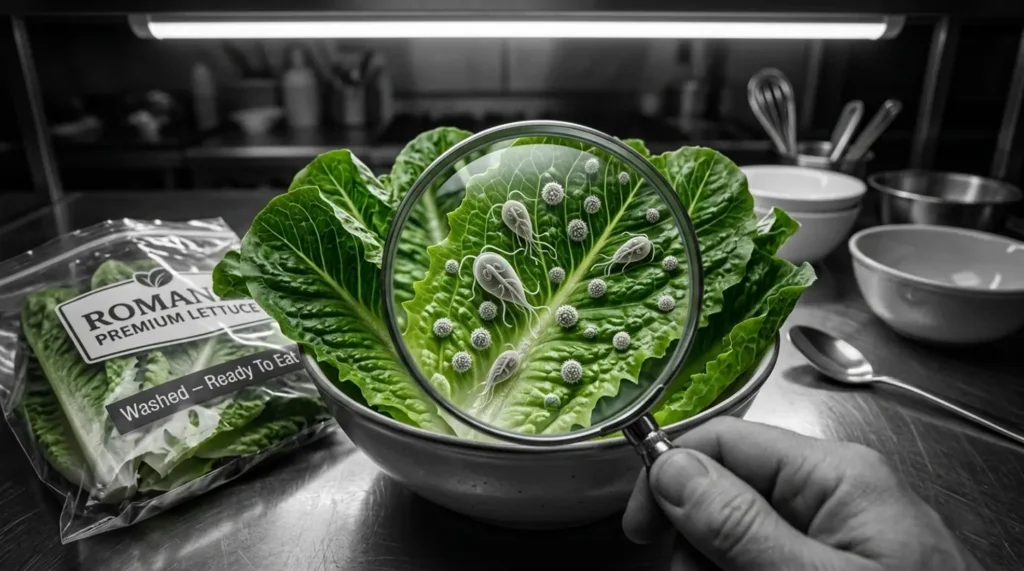
The Enemy’s Profile: These parasites cannot be seen with the naked eye. They protect themselves inside a shell (cyst) that allows them to survive for months in water and resist normal chlorine concentrations in commercial kitchens. Their origin is directly linked to irrigation water contaminated with human or animal fecal matter.
Kitchen Vectors: The false security of «ready-to-use» salads. The cold-station operator receives romaine lettuce, spinach, or tender greens. Since the supplier’s bag says «pre-washed,» they pass them directly to the buffet bowl or rinse them superficially in a sink where dirty utensils were previously washed. The corrugated leaves trap the microscopic cysts, which pass cleanly onto the plate.
Physiological Effect: Giardiasis and Cryptosporidiosis. They cause profuse and chronic watery diarrhea, severe dehydration, intense abdominal cramps, and drastic weight loss. In the case of Cryptosporidium, symptoms can last for weeks and be fatal to immunocompromised patrons.
Kitchen Control Practice:
- Immersion washing and vigorous mechanical agitation of leafy vegetables so that cysts detach through friction and drop to the bottom.
- Use of certified specific sanitizers for cyst elimination (such as chlorine dioxide or ozone), strictly respecting ppm and contact times, as traditional chlorine at 100 ppm exhibits low efficacy against Cryptosporidium oocysts.
Specimen C: Taenia solium and Taenia saginata (The Flatworms of Meats)
Cestodes of substantial length whose larval stage (Cysticercus) colonizes the muscular tissue of pork and beef, respectively.
The Enemy’s Profile: In meat, the parasite presents as small, whitish or ovoid cysts the size of a rice grain (commonly called cysticerci). If the cook slices a primal cut and fails to inspect the marbling, these larvae enter the consumer’s body alive.
Kitchen Vectors: The trend of «pink pork trend», beef carpaccio and steak tartare. The restaurant purchases meat from informal slaughterhouses (clandestine facilities) to cut costs. The grill cook prepares a pork loin and, to keep it «juicy,» serves it medium (below the safety temperature), leaving the thermal center deep within the Temperature Danger Zone (TDZ).
Physiological Effect: Tapeworm infection (Taeniasis) and Tissue Parasitic Infection. If the customer ingests the live larva in undercooked meat, it develops in their intestine as a tapeworm up to 4.5 yards long. Furthermore, if poor staff hand hygiene transfers Taenia solium eggs to a ready-to-eat food item, the customer will develop Cysticercosis, causing larvae to migrate to the brain (neurocysticercosis), resulting in seizures, blindness, and permanent neurological damage.
Kitchen Control Practice:
- Absolute prohibition of purchasing meats from suppliers lacking an official federal, government, or official veterinary inspection stamp guaranteeing the carcass is free of cysticerci.
- Cook pork and beef cuts to the minimum internal temperatures required by Codex and ServSafe, ensuring the thermal destruction of cysts.
Food Safety Manager’s Summary Note
In the parasite kingdom, operational control cannot be delegated to chemical sanitizers in the prep sink. A Cryptosporidium cyst mocks chlorine, and an Anisakis easily survives the lime juice in ceviche. The only two infallible control practices in a restaurant are strict extreme cold chain management (commercial prophylactic freezing) and origin certification from approved suppliers. The Food Manager Professional teaches that the cost of an informal supplier is the price of a legal lawsuit for permanent neurological damage in the dining room. Recreating culinary preparations from other regions sometimes requires recreating and optimizing preventive processes to ensure food safety.
Angelo Campione – FMP