HANDWASHING
THE INVISIBLE SHIELD
In high gastronomic management, excellence is not only measured in plate presentation or the harmony of flavors; it is consolidated in the invisible and rigorous architecture of food safety. There is an extraordinarily simple risk mitigation tool, yet frequently underestimated both in professional foodservice kitchens and at our home tables: proper handwashing.
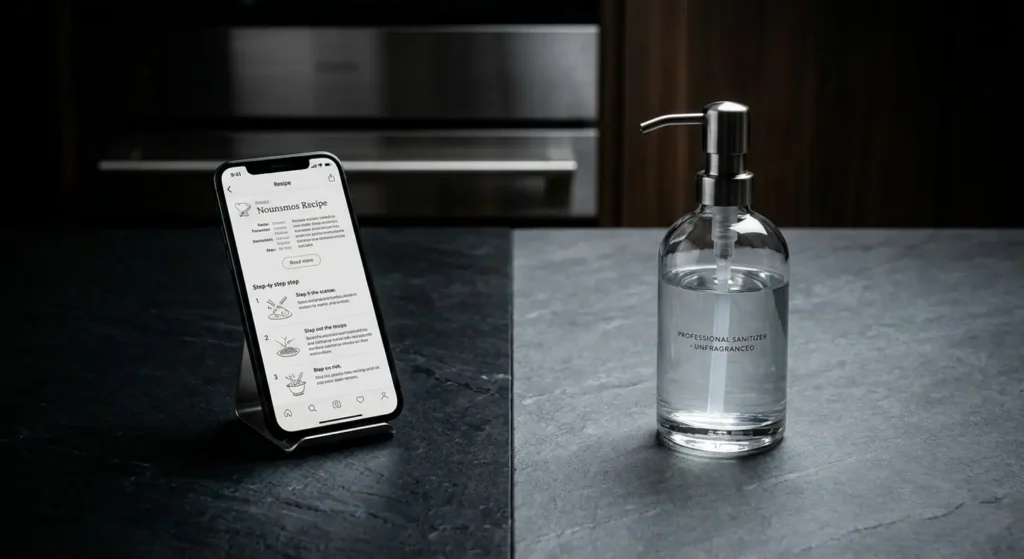
Far from being a sterile formalism or an exaggerated ritual, the science behind the guidelines and recommendations of health authorities or organizations like the National Restaurant Association (NRA) reminds us that handwashing is a dynamic measure of vector control. It does not seek the absolute sterilization of tissue—which is biologically unviable in a professional or domestic food service operation—but rather to keep breeding grounds for bacterial multiplication reduced and controlled. It is a temporary shield; a barrier that requires constant renewal because contamination is a fluid process that advances with every second of activity.
The Golden Rules of Microbiological Control
For handwashing to function as a true safety strategy, we must demystify certain practices and incorporate precise technical parameters that save lives, both on the production line and in the domestic environment:
- The Myth of the Glove: Under no circumstances does the use of gloves replace handwashing; their function is purely complementary. Pathogens proliferate with extreme ease in the warm and humid environment generated inside the glove. If hands are not thoroughly washed before putting them on, a latent source of contamination is being sealed in.
- The Time Variable (The Biological Clock): When an operator handles the same type of food without gloves, the washing protocol must be strictly repeated every 20 minutes—or immediately if switching tasks, ingredients, or functions. If gloves are used for the same type of food, the operational margin can be extended up to a maximum of 60 minutes, at which point it is mandatory to remove them, wash the skin, and renew the equipment.
- Optimization in the Absence of Hot Water: Ideal standards demand water at an appropriate temperature to favor the emulsification of fats. However, if a handwashing station temporarily lacks hot water, the authorized contingency strategy consists of executing the traditional wash and reinforcing the final disinfection power by finishing the process with the application of an unscented antibacterial gel, thus avoiding the transfer of aromatic chemical agents to the food.
- Drying as a Critical Phase: It is useless to remove the bacterial load if the drying process reintroduces contaminants. The exclusive use of single-use paper towels approved for foodservice operations is imperative. Cloth towels or shared linens are, by definition, an ecosystem for bacterial multiplication that negates the previous effort.
The Anatomy of Friction
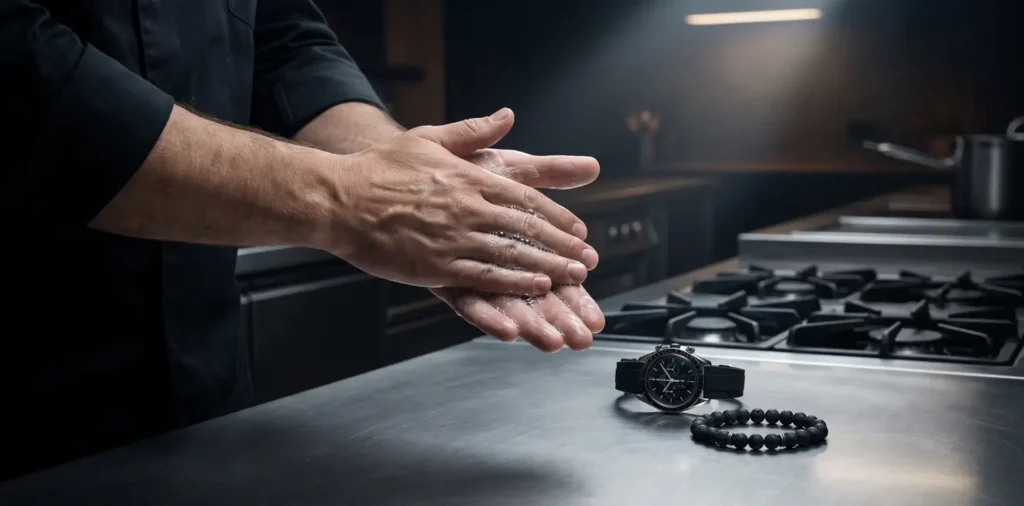
Handwashing is not a superficial gesture of courtesy. To break the surface tension where microorganisms adhere, the procedure demands a deep mechanical approach. Vigorous friction must be applied using antibacterial soap (unscented in the case of the food operator), emphasizing the wrists, the palms, the back of the hands, and the webbing between fingers, as well as under the nails. For the professional operator, this anatomical map obligatorily extends along the entire forearm, covering any area of exposed skin where the sleeves of the uniform do not cover. Upon completion, the hands and washed areas must be dried completely with approved disposable paper towels, and reinforced with antibacterial gel if the handwashing station lacked hot water.
Finally, it is important to understand that although in our line of business, we must be fast and precise to satisfy customer expectations; haste must not be a pretext to cast aside measures for the prevention of FBIs (Foodborne Illnesses). – We must work fast and safe.
Angelo Campione – FMP
Complementary Sources
The Psychology of the Hidden Touch: Why Your Eyes Deceive You
There is a fascinating and invisible disconnection between what we touch and what we consciously process. Psychologically, we tend to consider frequent handwashing as a punishment or an annoying interruption, because our cognitive system suffers from a visual validation bias: if the hand looks clean, the mind assumes it is safe. We forget with alarming ease that within a 20-minute span, while cooking or eating, we subconsciously interact with an endless number of highly contaminated physical and digital surfaces. Checking a message on a smartphone, adjusting commands on an iPad to read a recipe, or arranging a chair before taking bread from the table are automated actions that break safety in a second. Frequent handwashing is not a penalty on your time; it is an awakening of sensory and operational awareness that reminds us that true haute cuisine begins long before turning on the fire: it begins with the absolute control of what we transmit through touch.
Sylvana Bianchi – MD