CROSS-CONTAMINATION AND CROSS-CONTACT ─ PART 1
ESSENTIAL COGNITIVE KEYS FOR DIFFERENTIATION
F&B INDUSTRY TACTICAL GUIDE (PART I): DISMANTLING THE MYTH OF CROSS-CONTAMINATION
In the high-level management of hospitality and foodservice operations, biological safety is not an optional element; it is the invisible foundation upon which a brand’s reputation and operational continuity are built. However, there is a widespread cognitive dissonance in professional kitchens when mixing food safety terminology. The first step toward operational hegemony is conceptual clarity. Let us deconstruct the phenomenon of microbial transfer.
The Invisibility Bias in the Kitchen
The human brain suffers from an intrinsic cognitive bias: we tend to underestimate what we cannot see with the naked eye. In the hyperactive environment of a gastronomic production line, a line cook under pressure prioritizes aesthetics, temperature, and plate pickup times. Pathogens (bacteria, viruses, and fungi) operate in a microscopic dimension, leading personnel to relax biomechanical hygiene protocols by not perceiving an immediate danger. Applied behavioral psychology demonstrates that to modify a risk behavior in food handling, we must transform the invisible hazard into a factor of conscious and standardized control.
Audit and Control of Cross-Contamination
Cross-contamination is strictly defined as the involuntary transfer of biological pathogens from a food, surface, or infected human vector to a Ready-to-Eat (RTE) food. The danger lies in the fact that these microorganisms possess the capacity to multiply exponentially if exposed to time and temperature abuse, triggering Foodborne Illnesses (FBIs).
To mitigate this vulnerability in the operation, we must divide the risk vector into two transfer methodologies:
A. Direct Cross-Contamination (Immediate Physical Contact)
Occurs when a raw product classified as Potentially Hazardous (TCS – Time/Temperature Control for Safety), such as poultry, red meat, or unpasteurized dairy, enters into direct physical contact with foods that do not require subsequent cooking prior to consumption (such as fruits, salad vegetables, iceberg lettuce, or tomato).
- Critical Scenario: Incorrect storage in refrigeration walk-ins, where the juices of a raw piece of meat drip directly onto a tray of vegetables located on a lower rack, or even in the absolute absence of physical barriers (plastic film or sealed airtight containers).
B. Indirect Cross-Contamination (Vectors and Tools)
Here, the pathogen utilizes an interface or vehicle to relocate. The raw food and the food ready for consumption never touch, but the bacterial load is vectorized through:
- Cutting tools and the bowls containing them: The use of the same polyethylene cutting board or knife to fillet raw chicken breasts and, immediately afterward, slice artisanal bread without an intermediate chemical disinfection.
- Operator Biomechanics: The hands of the line cook who manipulates the raw product and then executes the final plating, transferring bacteria such as Salmonella or E. coli within the folds of the epidermis or under the fingernails.
Immediate Mitigation Plan:
- Strict Color-Coded Zoning: Implementation of cutting boards and knives with international color codes (Green: produce; Blue: seafood; Red: red meat; Yellow: poultry). This reduces human error margins caused by fatigue.
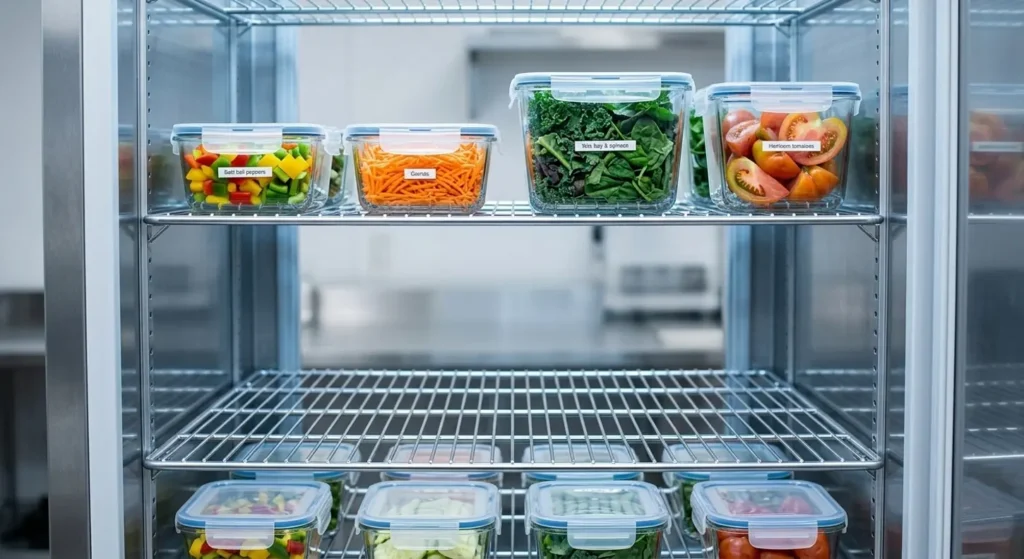
- Vertical Storage Hierarchy: Organizing refrigerators under the principle of final cooking temperature (Ready-to-Eat foods on the top shelf; whole fish and whole cuts of beef/pork in the middle; ground meats below them; and raw poultry on the lowest section).
- Hermetic Barrier Systems: Replacing the informal use of plastic wrap with industrial polycarbonate containers featuring visible dating and high-resistance sealing.
Angelo Campione ─ FMP