THE ILLUSION OF CLEANLINESS
WHY SOAP AND WATER ARE NOT ENOUGH TO GUARANTEE FOOD SAFETY
In the food and beverage industry, as well as in our homes, there is an invisible line between what looks clean and what is actually safe. For the untrained eye, a shiny surface or a cutting board without stains are synonymous with protection. However, from the perspective of biochemical architecture, this is nothing more than an optical illusion. Understanding the critical difference between apparent cleanliness and effective disinfection is the first step to establishing real operational safety that guarantees the health of customers and family members.
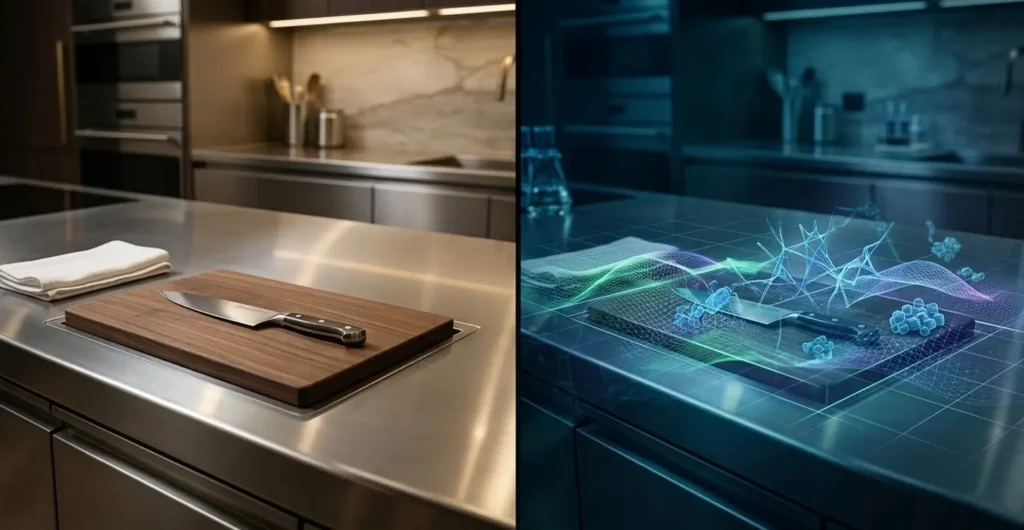
1. Cleaning vs. Disinfection: The microscopic frontier
- Apparent Cleanliness (Cleaning): This process uses water and specialized detergents to remove organic matter, grease, and visible residues. It is a mandatory initial mechanical phase, which only clears the ground; it does not neutralize the underlying biological threats.
- Sanitizing and Disinfecting (Pathogen Control): This is the directed application of formulated chemical agents (such as chlorine or diluted quaternary ammonium) professionally designed to stabilize, control, and drastically reduce the load of pathogens (bacteria and fungi) to safe levels.
- The Medical Distinction (Sterilization): It is vital that operators and consumers understand that disinfection is not sterilization. Sterilization —executed through high-pressure thermal systems such as autoclaves in clinical environments— completely eradicates any form of microbial life. Disinfection, on the other hand, does not seek radical eradication, but rather the strategic disruption of the biological reproduction cycle, which is why to guarantee a safe environment of operation and consumption, it must be practiced continuously and consistently.
2. Breaking the logarithmic growth phase
Bacteria possess an exponential multiplication capacity; under optimal conditions of time, temperature (5 °C ─ 57 °C / 41 °F ─ 135 °F) , relative humidity higher than 60%, and nutrients, a colony of Staphylococcus aureus, Campylobacter jejuni, Salmonella spp. or its Typhi or enteric variant, can double its population every 20 minutes. This vertical peak is what we know as the logarithmic growth phase.
Routine cleaning alone does not stop this clock; it simply redistributes the microorganisms over the surface. Real disinfection acts as a mechanical brake that breaks this reproductive chain, halting bacterial multiplication and preventing them from reaching the critical mass necessary to infect or to trigger an outbreak of Foodborne Illnesses (FBIs) such as Salmonellosis, Listeriosis, or E. coli infections.
3. Consumer Guide: What to look for in the market
When selecting sanitizing agents, both the professional operator and the domestic consumer must look beyond pleasant fragrances. The focus must be centered on the certified active components prepared by professional agents and firms of prestige:
- Chlorine-based Formulations: Highly effective for high-traffic surfaces, acting by rapid cellular oxidation.
- Diluted Quaternary Ammonium: Ideal for technical equipment and food contact areas due to its residual action and low corrosivity.
Angelo Campione ─ FMP
Additional Sources
Psychology behind the Blind Spot of Cleanliness (Neuro-Behavioral Analysis)
From a psychological perspective, human beings suffer from a cognitive confirmation bias regarding hygiene. Because our evolutionary system is designed to detect macro-threats (dirt, mud, decomposition), the brain registers the elimination of visible grime as a completed preservation task. This creates a dangerous subconscious blind spot: the operator or consumer genuinely believes that a clean-looking surface is a safe surface, discarding bacteria as an abstract or theoretical concept (due to the impossibility of visual confirmation without special equipment). Overcoming this resistance requires transforming disinfection into an unquestionable metric of operational discipline, understanding that true safety begins precisely where human vision ends.
Sylvana Bianchi ─ MD