THE PABELLÓN
A VENEZUELAN DISH, ABSOLUTELY SUBVERSIVE
There is an utterly sickening academic sentimentality that, to this day, brainy sycophants of local culinary anthropology continue to force: the symbolism of the contemporary national flag onto the national dish. We have been sold a series of «chromatic effects» worthy of Melquíades in a Macondian circus, where lecturers with an excess of lyrics and a lack of operational concrete assure us, without blushing, that «if one tilts their head and observes the black beans under a certain daylight, at a certain hour of the afternoon, and at a certain time of the year (leap year; of course), one will undoubtedly notice a blue reflection or tint» to represent the central stripe of the Republic’s tricolor. Well, well! —and since we are on the wavelength of bluish aurora borealis and the most elaborate gaslighting— naive friends of local gastronomic mysticism: I would hold my breath before such an exercise in visual hallucination, lest you end up turning blue yourself upon looking into the mirror.
Let us leave sarcasm aside and apply common sense and the rigor of real history. The name of the dish does not pay tribute to the subsequent republican flag, but to the true, irreverent, and Masonic ensign (Pabellón): the tricolor war flag of Francisco de Miranda. A libertarian standard composed precisely of three horizontal stripes: Yellow, Red, and Black. In fact, the current flag of the Miranda state. A BLACK stripe, carajo. Black at any hour of the day, viewed from any angle and under any lighting, without the need to invent chromatic-leguminous delusions.
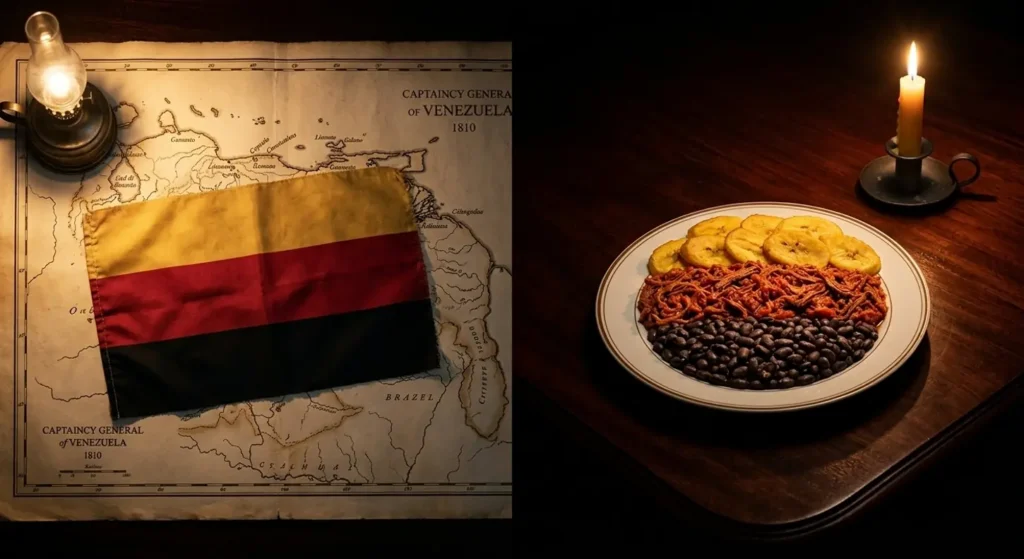
The dish is structurally and institutionally subversive. It was born in the kitchens of the opulent Mantuano estates, executed by domestic female slaves. They were not maroon rebels hidden away in a mountain; they were women, mostly second-generation slaves, raised within the core of the Royalist family since birth. Paradoxically, they implemented one of the most peaceful, subtle, and devastating forms of political protest of the era. One must understand the kitchen environment of that time: within Mantuano households, there was a neurotic panic regarding arming the African servants with blades. Therefore, the cutting tool par excellence in colonial stoves was the grater. The slave was technologically castrated by being deprived of knives, which is why our traditional cuisine is flooded, to this day, with procedures based on grated onion and grated tomato.
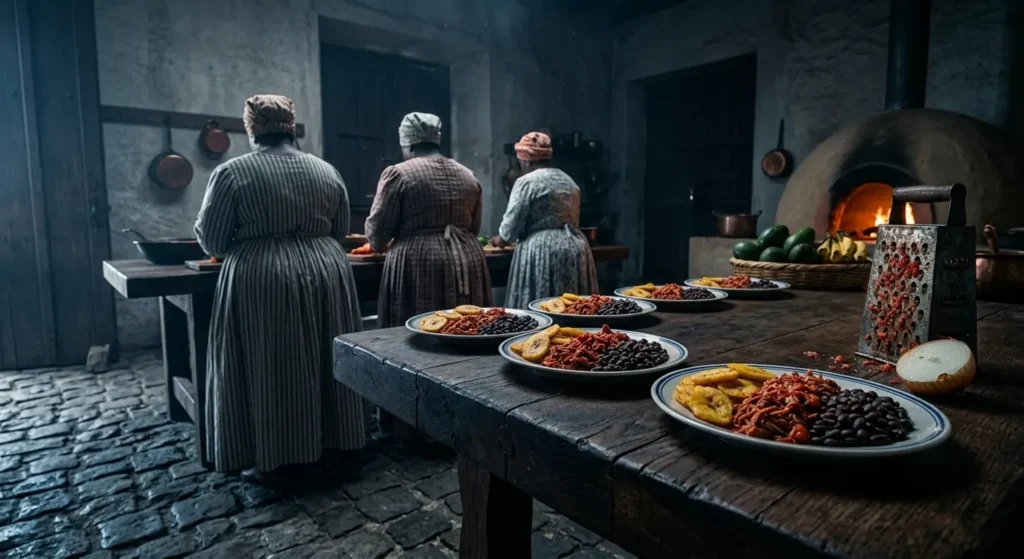
Deprived of steel but overflowing with cunning and symbology, these women configured the plating in a strictly geometric manner, ensuring that each food item remained confined to its own quadrant by color, without mixing. Placing the yellow of the fried plantain, the red of the tomato-infused shredded beef —grated with the patience of a goldsmith— and the rustic black of the beans, all of this accompanied by white rice, onto the table of the Mantuanos and Royalist Spaniards was a colossal defiance. It was shoving Miranda’s libertarian banner down the enemy’s throat right under their noses. A silent rebellion chewed in the main dining room. The Pabellón is no simple nutritional exercise born from leftovers; it is a geopolitical Trojan horse, a sacrament of quiet resistance proving that liberty in these latitudes was not only conquered with gunpowder on the battlefield, but was cooked, grater in hand, within the bunker of colonial kitchens.
Angelo Campione ─ WCCE