THE GEOGRAPHY OF FIRE
THE BARBECUE AS A SOCIAL RITUAL
There is a zoological truth that the establishment of haute cuisine tries to bury under tons of minimalist aesthetics—with its plating tweezers, alginate gels, Parmigiano «foams», and spherifications of clarified sweet chili juice extracted from left-handed bonsai shrubs: we remain frightened hominids seeking refuge around a burning ember.

While contemporary etiquette manuals bend over backward to teach us the correct use of the third fork, our species’ cellular memory knows perfectly well that the only truly democratic space is found around the perimetric fire. The formal table imposes hierarchies and distances; the fire, on the contrary, returns us to the tribe.
But let us make no mistake. We are not here to talk about the delicacy of poultry or the subtle thermal behavior of a fish fillet. Those are culinary accidents for docile palates. The true hominid magnet demands the intramuscular fat of mammals, rustic collagen surrendering to the heat, and the chemical signature that only beef or the noble pig—Rex mammalium—can bequeath to the smoke. It is there where the figure of the Master Grill-Handler emerges, that shamanic guardian of the protein faith whom the community observes with an almost religious reverence. He is not a simple cook; he is the administrator of the totem, the initiate who holds the power to transform muscle tissue into a collective sacrament and dictate the times of the vigil.
This phenomenon understands no borders, only fleshly latitudes. The invisible threads of this ritual connect the obsessive technical precision of the American BBQ with the almost mystical liturgy of the Rioplatense asado. In our lands, the matter reaches legendary heights with the Venezuelan carne en vara, a horizontal communion where the animal is suspended facing the direct heat, to be irradiated and caressed by tongues of fire, defying urban haste. And if we look toward the Atlantic, we run into the traditional Portuguese espetadas: those sirloin chunks pierced by sharpened laurel branches, slathered with lard and garlic, dripping their juices placidly over the charcoal. Even if we travel to the Old World under the format of shish kebab or doner, the psychological principle remains unaltered: man needs to subdue the beast through fire to calm his own brutal nature.
However, the miracle does not happen under the sunlight. Sunday lunch is barely a family simulacrum. The true social amalgam ignites at night, when the shadows force the tribe to close ranks around the embers. It is in the seduction of the dark side where the fire deploys its hypnotic power, acting as the perfect lubricant for adults to share the meat, uncork the alcohol, and release anecdotes and songs.
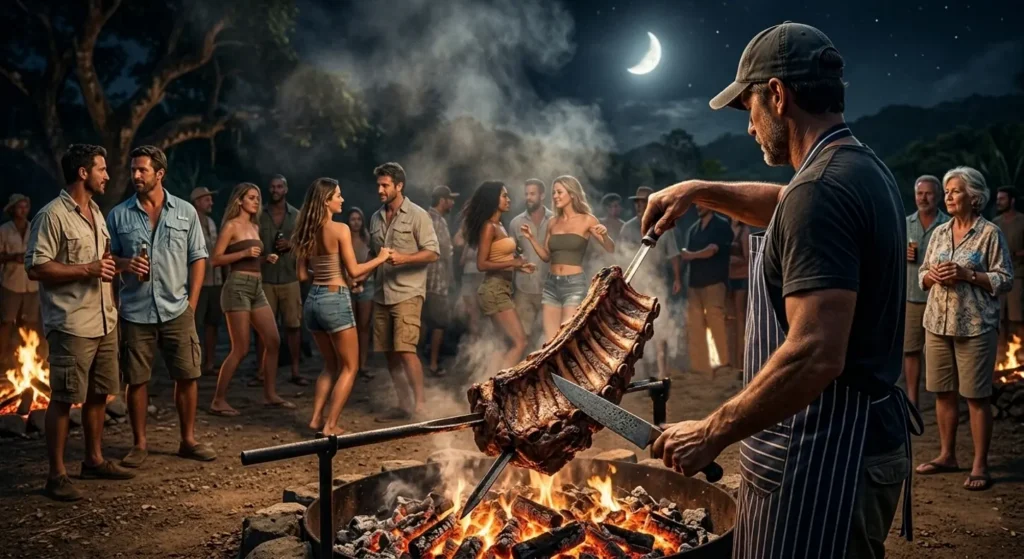
In that instant, time slows down in a histrionic, ancestral, and subtle representation of the triumphant arrival of hunting parties — the dance and public pageantry serving as a social runway to determine power roles and configure the connections necessary to guarantee continuity; the socially acceptable showcase to promote mating and its rituals. The heat of the ember purifies the space and unifies what the city’s routine fragments, proving that, after ten thousand years or perhaps much longer, we still need fire, nocturnality, ethanol, and the sacrifice of the mammal to remember that we are alive.
Angelo Campione – WCCE