PAELLA
THE TRADITIONAL SPANISH DISH CONCEALS A VERY POSSIBLE GENOESE ORIGIN
There is an utterly rustic culinary chauvinism that the establishment of domestic historiography defends as an unshakeable dogma of faith. We have been sold the idyllic fable that the paella is a peasant invention born out of romantic spontaneity within the rice fields of the Valencian Albufera back in the 17th century. However, when the scalpel of documentary analysis and operational common sense is applied, the «kilometer zero» farce crumbles under the weight of its own mythology. Dear bastards of the unblemished tradition: the traditional Spanish dish, as it is known today, has an origin just as Valencian as Christopher Columbus was Valencian.
Let me not be misunderstood in a simplistic manner. I do not come here to claim that the dish is not Spanish. What I argue, with the documentary evidence on the table, is that the cooking technique, the structure of the grain, and the vessel in which it is executed are a direct inheritance from Liguria. Genoa and its 15th century chronologically precede the 17th century of the Albufera by more than two hundred years. The argument is irrefutable: long before the paella was baptized in Iberian lands, the coast of Liguria was already consuming dry and broth-based rice dishes with meats and fish, seasoned with saffron, prepared in exactly the same manner, and executed in the very same PADELLA. [1]
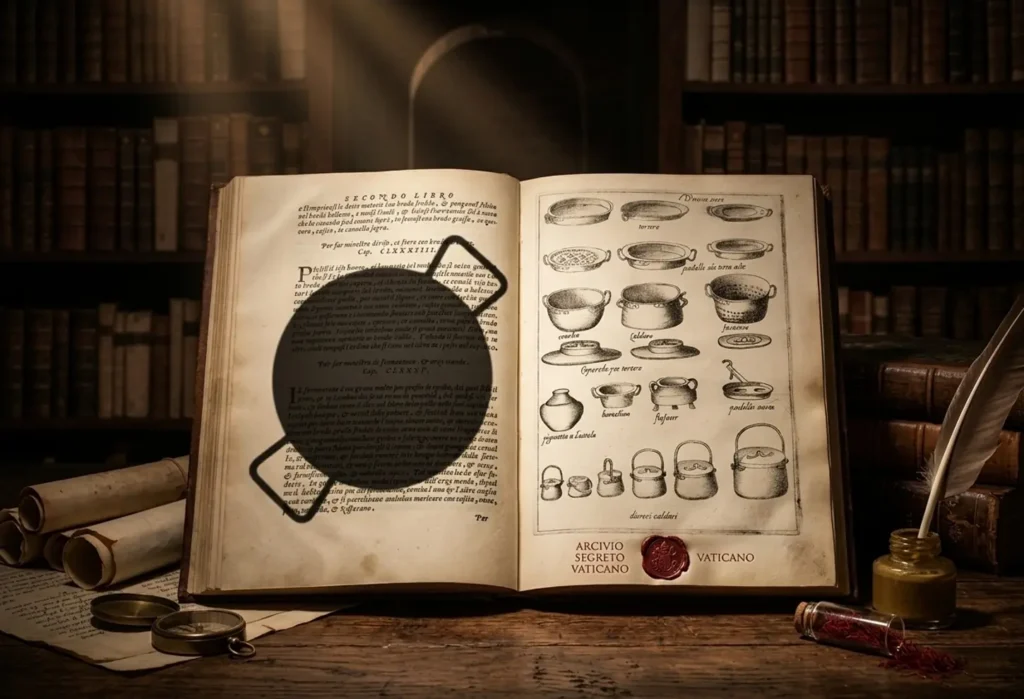
The smoking gun rests within the engravings and texts of the Opera dell’arte di cucinare di Bartolomeo Scappi, Cuoco Secreto di Papa Pio V (1570), the culinary genius of the Renaissance. In his technical catalog of utensils, Scappi draws with milimetric precision the double-handled pans officially labeled as «padelle da torta alte». The vessel is one hundred percent Italian; Spanish commercial phonetic deformation simply extirpated the «D» to nationalize the recipient. But Scappi goes further than iron. In the Secundo Libro, pages n143 and n313, the printed text systematically registers the spelling and phonetics of the grain: «RIFO». In the chapter «Per far minestra di rifo… con brodo di carne» and within the maritime preparations of the «Minestra di rifo in brodo di pesce», Scappi details the technique of pouring the grain directly into concentrated fatty broths so that it absorbs the pure essence of the beef or the sea, tinting the canvas with the mandatory presence of «zafferano» (saffron). [2]
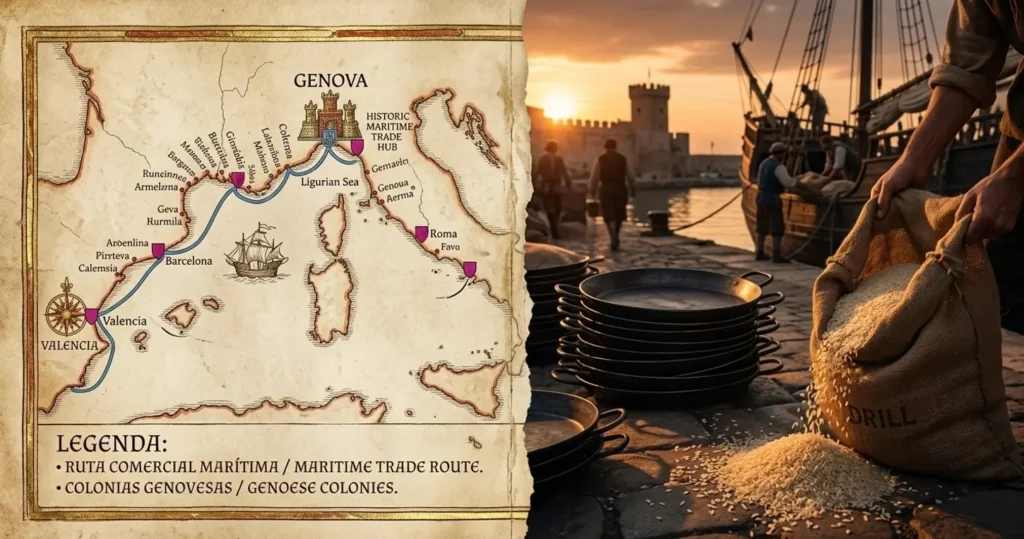
While in Genoa saffron-infused rifo in a padella was a consolidated reality, the cultivation of rice in Valencia was severely prohibited and persecuted for more than three hundred years by the Crown of Aragon [3] due to the devastating outbreaks of malaria and tertian fevers caused by stagnant waters. From Pere IV the Ceremonious in 1342 to the punitive pragmatics of Charles V in 1526, the law forced rice to be kept away from populations, turning the idea of a popular development of the dish in 15th-century Valencia into a biochemical and economic impossibility. How then was daily consumption sustained on the Mediterranean coast? Through importation. Valencia hosted stable neighborhoods and colonies of Ligurian sailors and financiers—the powerful merchant houses of the Di Negro and the Centurione—who controlled the maritime logistics of the era. It was they who brought the method, the dry grain, and the vessel. Local chauvinism only had to change the «F» for a «Z», seize the padella when 19th-century sanitation finally allowed the fields to be flooded again, and hang a medal that, in strict historical justice, belongs to the Ligurian Sea.
This argumentation I present joins a line of claimants, among which is the Basque Country, which also claims the genesis of the dish. Frankly, I couldn’t care less. I do not approach gastronomy within a static grid, nor under the bias of demonyms or reactive patriotism, «tearing my chef’s jacket» at the slightest offense like a Sadducean Kohen Gadol.
Nevertheless, I confess that I would be glad if the same Liguria that shared with Spain the distinguished Columbus and the structural «pieces» for the paella, received from the peninsula something more than silence; and certainly a more honorable treatment than that received by the Admiral of the Ocean Sea and his family in the rigged arbitration award of plundering of June 1536, where royal power annulled the Capitulations of Santa Fe with the stroke of a pen. An institutionally predictable outcome in the historical homeland of Ferdinand of Aragon, that of his heir Charles V, and that of their very loyal and contemporary continuators, Zapatero and Sánchez.
Angelo Campione─ WCCE